The good news: this is one of the easiest risks to check for, and a few smart questions before you make an offer can save years of hassle.
Why It's Worth Checking
Every boat needs servicing eventually — pumps need seals, engines need filters and belts, windlasses need switches and gearboxes. When parts are easy to find, that's just routine maintenance. When they're not, a small fault can turn into a bigger project: longer downtime, pricier sourcing, or replacing an entire system because one component let go.
None of this means a boat is a bad buy. It just means parts availability deserves a place on your due-diligence list, right alongside the engine hours and survey.
Key Systems to Check
You don't need to inspect every screw. Focus your time on the systems that are essential, expensive or trickiest to replace:
Engine and fuel system — manufacturer, model, serial number, and whether filters, belts, impellers and service kits are still supplied
Pumps — raw water, freshwater and circulation pumps, plus their seals and impellers
Electrical and charging — chargers, inverters, alternators, control panels and any proprietary cabling
Steering and thrusters — hydraulic components, thruster motors, control panels and solenoids
Windlass — motor, gearbox, gypsy and switches
Plumbing and sanitation — toilet model, pumps, valves and macerators
Heating, air-con and refrigeration — compressors, control units and sensors
Record the serial number
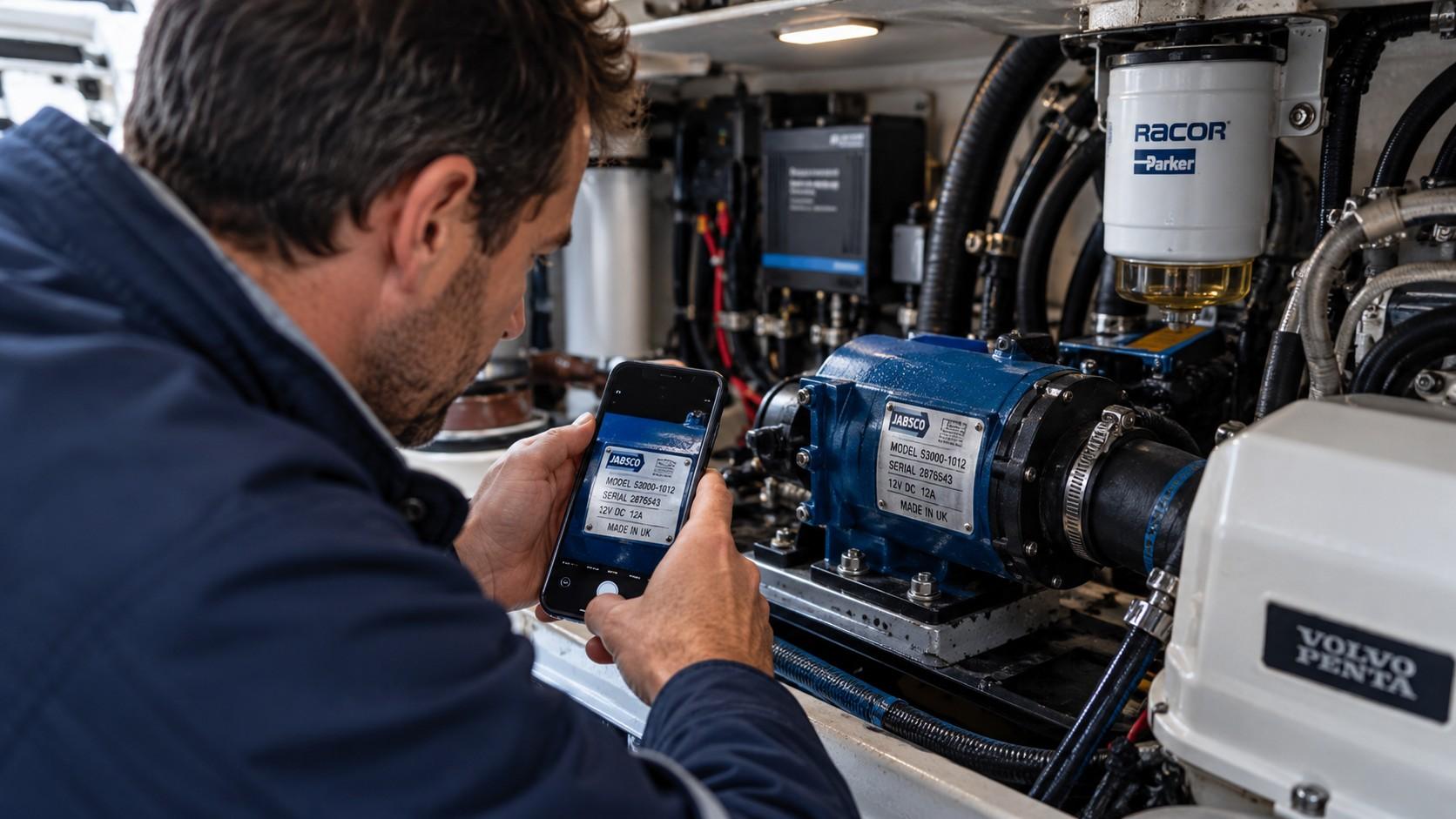
Marine components that look near-identical can have completely different fittings or electronics. Wherever you can, record the manufacturer, model, serial number, voltage and part number — a quick photo of the identification plate is often the easiest way. Searching by the exact part number, rather than a generic description, is what usually turns up the right result.
Check the status of the product
Installed equipment generally falls into one of three buckets:
Current — still in production, easy to service
Discontinued but supported — no longer made, but common parts are still supplied (very normal for established marine brands)
Discontinued and unsupported — original parts are hard or impossible to find
Only the third category needs real caution, and even then it simply means going in with clear eyes on future costs — not ruling the boat out.
While you're at it, check whether full service kits are available, not just individual parts. A manufacturer still selling seal kits or impeller kits for an older model is a good sign they're still backing their product.
Factor in Location
A boat in Australia or New Zealand may carry European engines, US electronics or parts from half a dozen countries. Before you buy, check whether there's a local distributor, what lead times look like, and whether you're looking at days or weeks for delivery. A part being "available" and a part being "available quickly" are two different things — and for anything safety-critical, that difference matters.
Older Boats Are a Mix, Not a Single Age
A well-loved older boat rarely has parts of the same vintage throughout. It might carry its original engine, a newer windlass, an older thruster and brand-new electronics, all at once. Rather than assuming an older boat will be hard to support across the board, it's worth assessing each major system on its own merits — sometimes the mechanical gear is the easy part, and it's the newest electronics that are already obsolete.
Ask for the Paper Trail
Manuals, service history and old invoices are gold here — they often carry exact part numbers no longer visible on the equipment itself, and service records can flag whether a previous owner already had trouble sourcing something.
Worth a Closer Look
A few situations are worth double-checking before you commit: missing identification plates, heavily modified systems with no documentation, or equipment where only used parts seem to exist. None of these are automatic dealbreakers — they're simply worth understanding before you sign.
Let It Work for You at the Negotiating Table
If a boat has an older charger, toilet, windlass or thruster that's still ticking along but no longer well supported, that's useful information — not necessarily a problem. It might run for years yet, or the next failure might call for a modern replacement. Either way, spotting it before you make an offer puts you in a much stronger position than discovering it afterward, and it's a completely reasonable thing to factor into your price.
How Yacht-Supply24 Can Help
Marine gear can stay on a boat for decades, so a parts search often means tracking down older models and superseded article numbers. Yacht-Supply24 works with equipment and spare parts across a wide range of manufacturers, covering many of the systems above. The fastest path to an answer is usually the same one: search by the original manufacturer part number to see whether it's still supplied or has a modern equivalent — useful before you buy, and just as useful for years of maintenance afterward.
Quick Checklist
Engine model and common service parts
Filters, belts and impellers
Raw water and freshwater pumps
Steering system
Bow and stern thrusters
Windlass and controls
Battery charger and inverter
Marine toilet and sanitation equipment
Heating, air conditioning and refrigeration
Manufacturer, model and serial numbers
OEM or article numbers
Service kit availability
Local and international lead times
Manuals and maintenance records