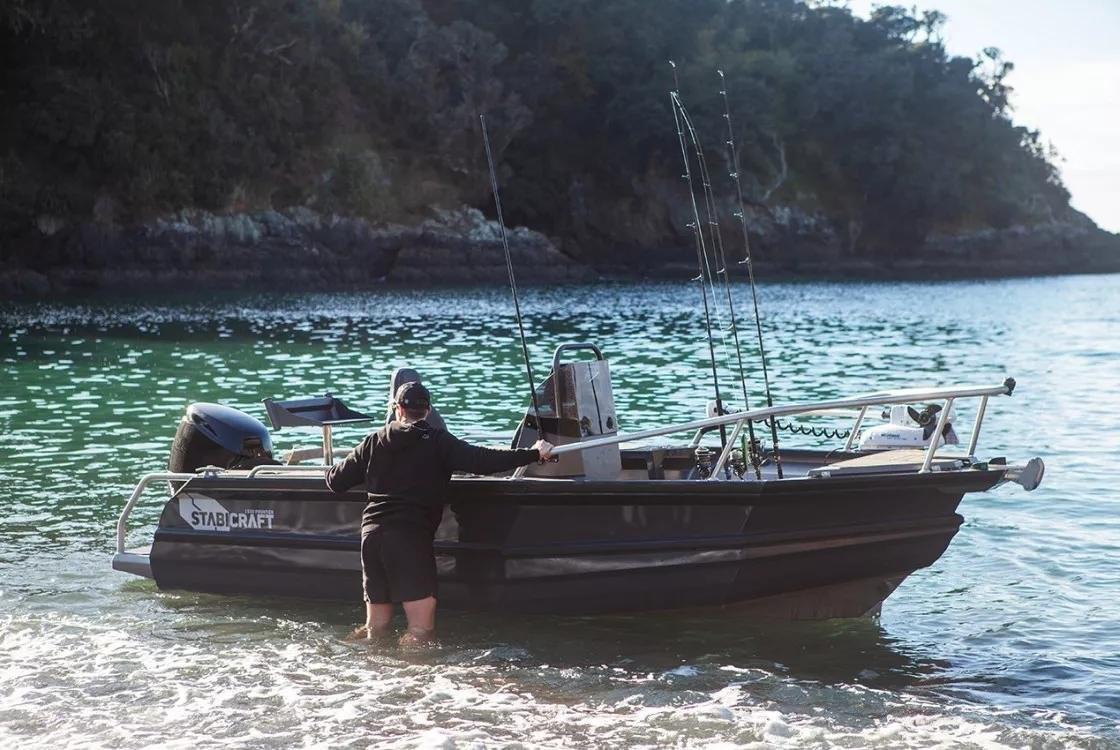
Beach launching straight off the sand is a good skill for any trailer boat owner, and it opens up a lot more options for your next adventure. The key is choosing your beach and conditions carefully, firm sand, reasonably sheltered water, decent access to the beach, and a close eye on the tide.
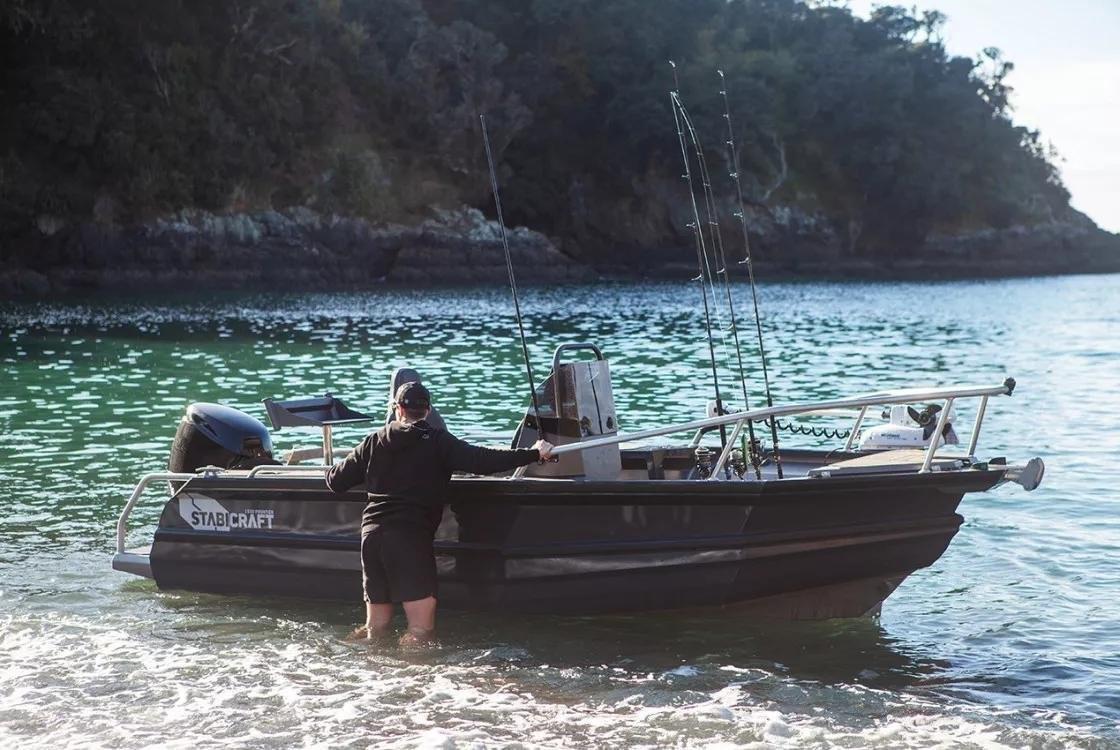
Choose Your Beach and Conditions
If you're new to an area, or to beach launching itself, start at a popular spot and watch how the locals do it. A busy, established launch is a good sign the beach works, and a few minutes watching people go in and out teaches you more than any amount of reading. Before you commit, walk the stretch you mean to use, check the sand is firm underfoot, and have a look through the shallows for anything you'd rather find now than with the lower unit.
When's the Best Tide to Beach Launch?
Planning around low tide is usually best, when the sand is at its firmest. The exception is an estuary or sheltered harbour with mudflats, where high tide is the better bet.
Either way, work out your launch and recovery timing before you go. The main thing is having a plan for where you want the tide to be when you come back in.
Do You Need a 4WD?
On soft sand, almost always. Engage 4WD and low range before you reach it, not after the wheels have started to dig in. If the sand's dry and loose, drop the tyre pressures a little to spread the weight, and carry a compressor to pump them up for the road. A firm, steep beach can sometimes be done in 2WD, but don't bet on it if you're unsure of the surface.
Driving it is about steady momentum rather than power. Stay in a low gear, keep the revs even, and hold a line instead of stopping and starting. Flooring it only spins the wheels and digs you in, and that's worst below the waterline, where wet sand can turn to something close to quicksand.
How to Launch off the Beach
Moving smartly is the key, so you want at least 2 people, ideally more. Before you start, make sure you're ready to motor out of the launch area straight away, bungs on, lifejackets on, motor ready to go. However, keep the motor all the way up until the boat's in the water and floating, as you may need to tip her a little to get her off the trailer. If you can't float her off without submerging the truck, disconnect the trailer and push the trailer in instead.
Getting the boat off the trailer and away wants to be brisk. Driving out through the waves doesn't. Take your time to find a calmer patch, keep your speed up through the flatter water, ease off over any cresting waves, then get going again once it's clear.
How to Get the Boat Back on the Trailer
The same thinking applies coming in. Waves arrive in sets of 3 to 6, so wait for a flat patch and drive in on the back of a wave. If there is current, line up two points on the land to help you steer in a straight line. Get the boat secured on the trailer, then don’t muck about. Pull forward with smooth and steady power in low gear until you’re off the beach.
If you can't get the truck and trailer far enough into the water, disconnect the trailer and float the boat onto it by hand. From there you can push the trailer up the beach, or pull it out with a rope or snatch strap if it has a jockey wheel with a pneumatic tire.
What Kit Do You Need?
A rope or snatch strap twice the trailer's length, rated D-shackles, a pneumatic jockey wheel, a tyre compressor, and a couple of round fenders that double as rollers. Not much to carry, and exactly what you'll want the one time you need it.
A New Way: Self-Driving Trailers and Remote Launchers
The newest change to beach launching does away with the tow vehicle altogether. A handful of electric systems turn the trailer itself into the thing that drives in and out of the water, and one of them comes out of New Zealand.
Tectrax, part of the Wave Propulsion Group alongside electric-jet firm ZeroJet, calls its Boat-Launcher the first fully electric, remote-controlled system of its kind. It's a self-driving trailer you steer from the helm with a handheld remote: you drive it down into the water, float the boat off, and send the empty trailer back up the beach to park itself. Coming in, guide poles and hull bunks feed the boat onto the trailer and an automatic bow latch captures it, so there is no need to step off.
Each wheel has its own hub-mounted electric motor, with the drive and steering fully electric and no hydraulics to service. The system puts around 5,000Nm of torque straight to the wheels and runs on a low-voltage 48-volt setup. Because the drive lives in the trailer rather than the boat, it fits any hull without altering the vessel. Tectrax builds it in different configurations to suit boat weight, from a 2-wheel drive up to a 6-wheel drive for heavier boats. It debuted at the Hutchwilco New Zealand Boat Show and has since gone offshore through trailer builders in the UK, Ireland and Europe.
Amphibious Boats: Skipping the Trailer Altogether
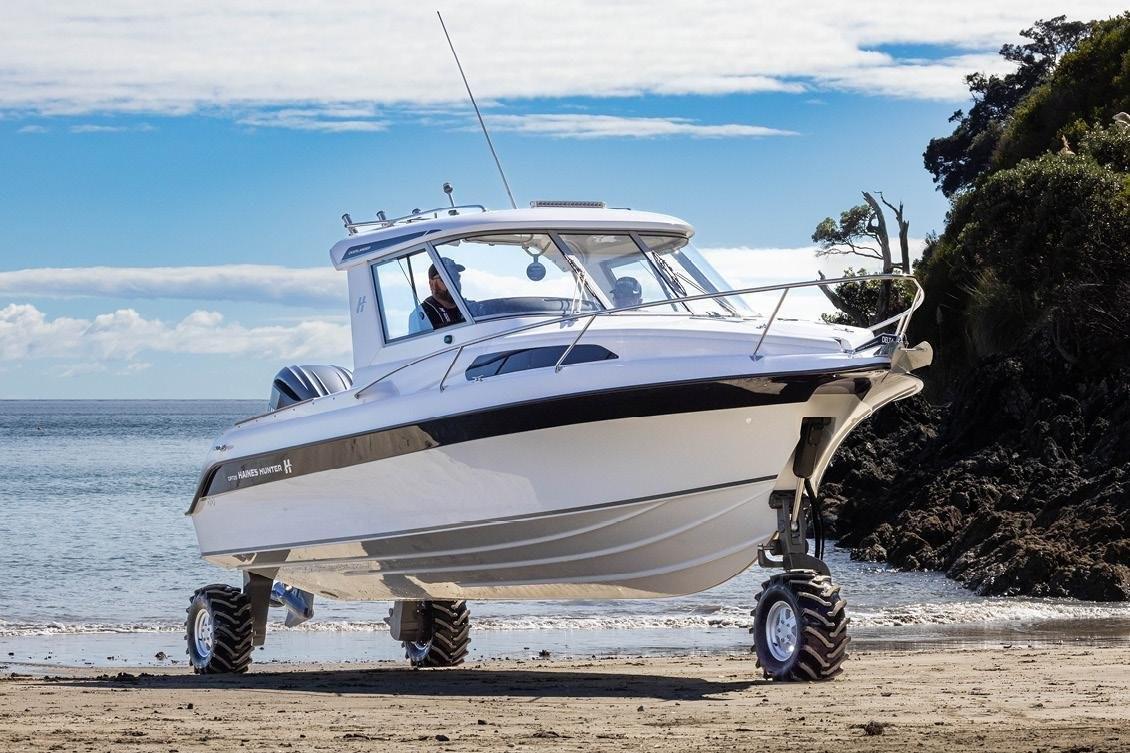
The other approach is to put the wheels on the boat. Amphibious craft carry motorised, retractable legs that let you drive down the beach, into the water, and away — then lower them again on the way back in and drive up the sand under your own power. No trailer in the water, no second vehicle, and nobody gets out.
Sealegs, based in Albany in Auckland, has been building them since 2005 and has shipped more than 1,850 craft worldwide. The system is a set of motorised, retractable and steerable wheels, 2 aft and 1 forward, fitted to purpose-built hulls. You drive down the beach on the wheels, retract them once you're floating, and run the boat normally on the outboard. Coming back, you lower the wheels while still in the water, troll in until they touch bottom, and drive up the beach. The range runs from a 3.8m tender through RIBs of 6.1m, 7.1m and 7.5m to a 9m model, and there's an electric version using hub-mounted brushless motors on a 48-volt battery, good for around 20 return trips up the beach between charges and much quieter than the petrol-hydraulic setup.
What's changed lately is that it's no longer a single-brand proposition. A growing number of New Zealand builders are adding amphibious models to their existing ranges, usually by fitting a wheel system from a specialist supplier to a proven hull. StabiX, an independent company led by Stabicraft co-founder Paul Adams, builds a range of 8 amphibious models from the 205 SuperCab up to the 290 UltraCab, with a choice of wheel systems. McLay Boats has the Raptor 741 Gen2, running the Tectrax system (the same company behind the remote trailer above) with the rear wheels retracting into the fenders so anchor rope and fishing lines stay clear of them. Extreme Boats has moved in with the 696 Xpedition, built on its Game King hull at 8.1m.
The obvious appeal is for waterfront homes, remote landings and superyacht tenders, where there's no ramp to use and the alternative is dragging a tender back down the sand as the tide drops. The catch is cost and scale, you're buying a boat built around the system rather than adapting one you own. But with more builders offering it on hulls people already know, it's worth understanding what's available before you commit to your next boat.
Getting Started
Beach launching isn't difficult, but it does reward preparation. Choose a forgiving beach, plan around the tide with a clear idea of where you want it when you come back, take a mate, and keep things moving once you're on the sand. Get those right and the rest follows. A few goes at a popular spot and it stops feeling like a production.
If you're thinking about a boat to do it in, the sweet spot is a trailerable hull that's light enough to handle on sand and tough enough for the surf line. Aluminium fishing boats and plate boats are the usual starting point, and if you'd rather skip the trailer altogether, the amphibious models are worth a look. Browse trailer boats for sale to see what's out there.
Frequently Asked Questions
What is the best tide for beach launching? Low tide is usually best, when the sand is firmest. The exception is an estuary or sheltered harbour with mudflats, where high tide works better. Either way, plan the trip around where you want the tide to be when you come back in.
Can any boat be beach launched? Smaller trailer boats suit it best — aluminium fishing boats, plate boats and runabouts. Heavier fibreglass boats can be launched off the sand, but they're harder work and less forgiving.
Do you need a 4WD to beach launch? On soft sand, almost always, ideally in low range with slightly lowered tyre pressures. A firm, steep beach can sometimes be done in 2WD, but it's not worth the risk if you're unsure of the surface.
How do you stop the trailer bogging in the sand? Keep moving, and never spin the wheels below the waterline, where wet sand can turn to something close to quicksand. Get on and off the wet sand quickly, and if it's too deep to reach without swamping the vehicle, uncouple and pull the trailer clear with a rope.
How many people do you need to beach launch a boat? At least 2, ideally more. The whole thing turns on moving quickly, which is far easier with one of you on the boat and one on the vehicle, each clear on the plan before you start.
Is beach launching safe? Yes, with preparation. Watch the swell heading out and coming in, keep the bow into the waves, and stay on top of the tide.
What is an amphibious boat? A boat fitted with motorised, retractable wheels, so you can drive it down the beach and into the water without a trailer, then retract the wheels and run it normally. Sealegs pioneered it in New Zealand, and builders including StabiX, McLay Boats and Extreme Boats now offer amphibious models in their ranges. It suits waterfront homes and remote landings, though you're buying a purpose-built hull rather than converting your own boat.
Do you need a permit to drive on the beach? Often, yes. Many councils in New Zealand and Australia require a vehicle permit, and some beaches limit or ban vehicles. Check the local rules first.